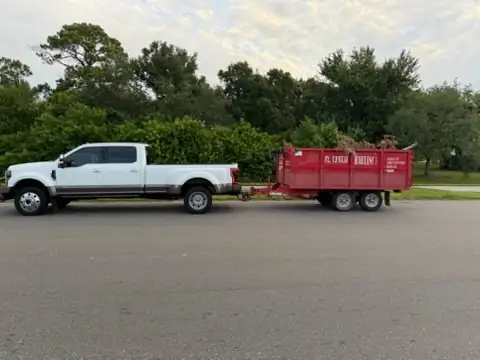
We get asked this a few times a month, usually by someone with a big truck and a good reason: the trailer is blocking a car, the driveway needs pressure washing, or a second pile is on the other side of the house. The answer is always the same. Please don't.
The trailer stays where it's delivered
The rental covers the trailer sitting where we place it, being loaded, and being collected by us. It does not cover it being towed by anyone else, for any distance, empty or full. That is a condition of the rental, and it's there for good reasons.
Why it's a bad idea
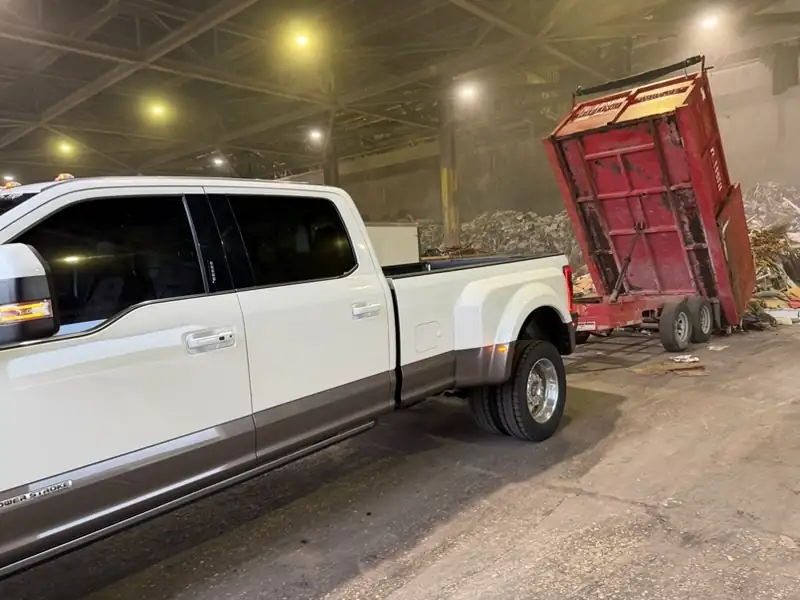
- Weight. A loaded 10-yard dump trailer can weigh far more than a typical pickup or SUV is rated to tow, and the tongue weight alone can overload a hitch. A loaded trailer behind the wrong vehicle is genuinely dangerous.
- Insurance. Our trailers are insured while we tow them. They are not insured for you to tow, and neither is whatever you hit.
- The hydraulics. The dump bed is not something to operate without knowing it. A tub raised on uneven ground can tip the whole trailer.
- The surface. We put boards down to protect driveways. Dragging a loaded trailer even a few feet on a hot Florida driveway leaves marks that don't come out.
Getting the placement right the first time
Most repositioning requests come from a spot that was chosen in a hurry. Before delivery:
- 1Decide where the material is coming from and put the trailer as close to it as the truck can reach.
- 2Leave room to open the tailgate fully and walk in.
- 3Keep the trailer clear of the garage door, the walkway, and any car that needs to get out during the week.
- 4Mark the spot with cones or a chalk line if you won't be home for delivery.
Photos of the driveway and the approach, sent with the booking, let us plan the placement before the truck arrives.
What about moving it on the property?
Same answer. Even a short move across a lawn or around a corner is a tow, with the same weight and hydraulics involved. If the job genuinely needs the trailer in two places, book it as two placements and we'll move it between them.
What the driver does that you don't see
Placement looks simple from the porch. It isn't. Before the trailer is unhooked, the driver has checked the surface for soft ground and slope, laid boards under the tires and the jack where the surface needs protecting, chocked the wheels, and confirmed there is overhead clearance for the dump bed to rise on pickup day. The trailer is then level, blocked, and stable enough to load a ton of material into without shifting.
Every one of those steps is undone the moment someone hitches it up and drags it ten feet. The boards stay behind, the chocks are gone, the new spot hasn't been checked, and a loaded trailer that settles into a soft patch of lawn can lean far enough to be unsafe to load and difficult to recover. Repositioning is a five-minute job for a driver who does it daily and an afternoon for anyone else.
The other thing the driver checks is the tow vehicle. Our trucks are matched to the loaded weight of the trailer, including the brakes and the hitch rating. A pickup that tows a boat comfortably is not necessarily rated for a trailer of wet tile, and the difference shows up at the first stop sign.
Frequently asked questions
Can I move it empty, right after delivery?
No. Empty or full, it stays until we collect it. If it's in the wrong place, call before you start loading.
Can I raise the dump bed to unload something?
No. The bed is operated by our driver at the facility. There's no reason to raise it during a rental.
Is there a fee to reposition?
If we placed it where you asked and you now want it elsewhere, we'll tell you if a fee applies when you call. It depends on the distance and the schedule.
Book a 10-yard dump trailer
Free local delivery, free pickup, and a family-owned crew that shows up when we say we will. Serving Clearwater, Pinellas, Hillsborough and Pasco.