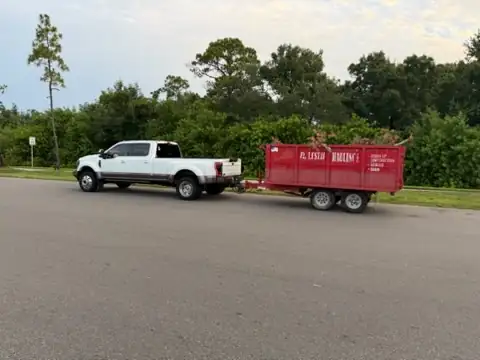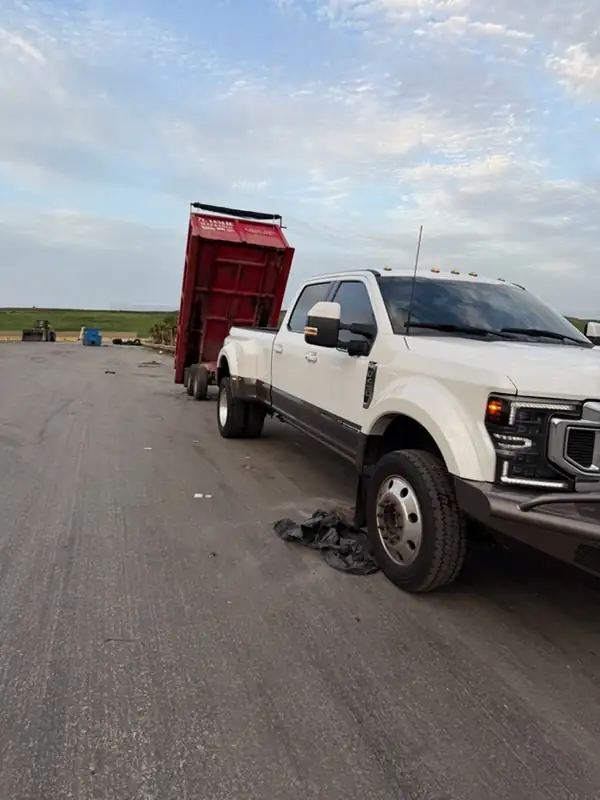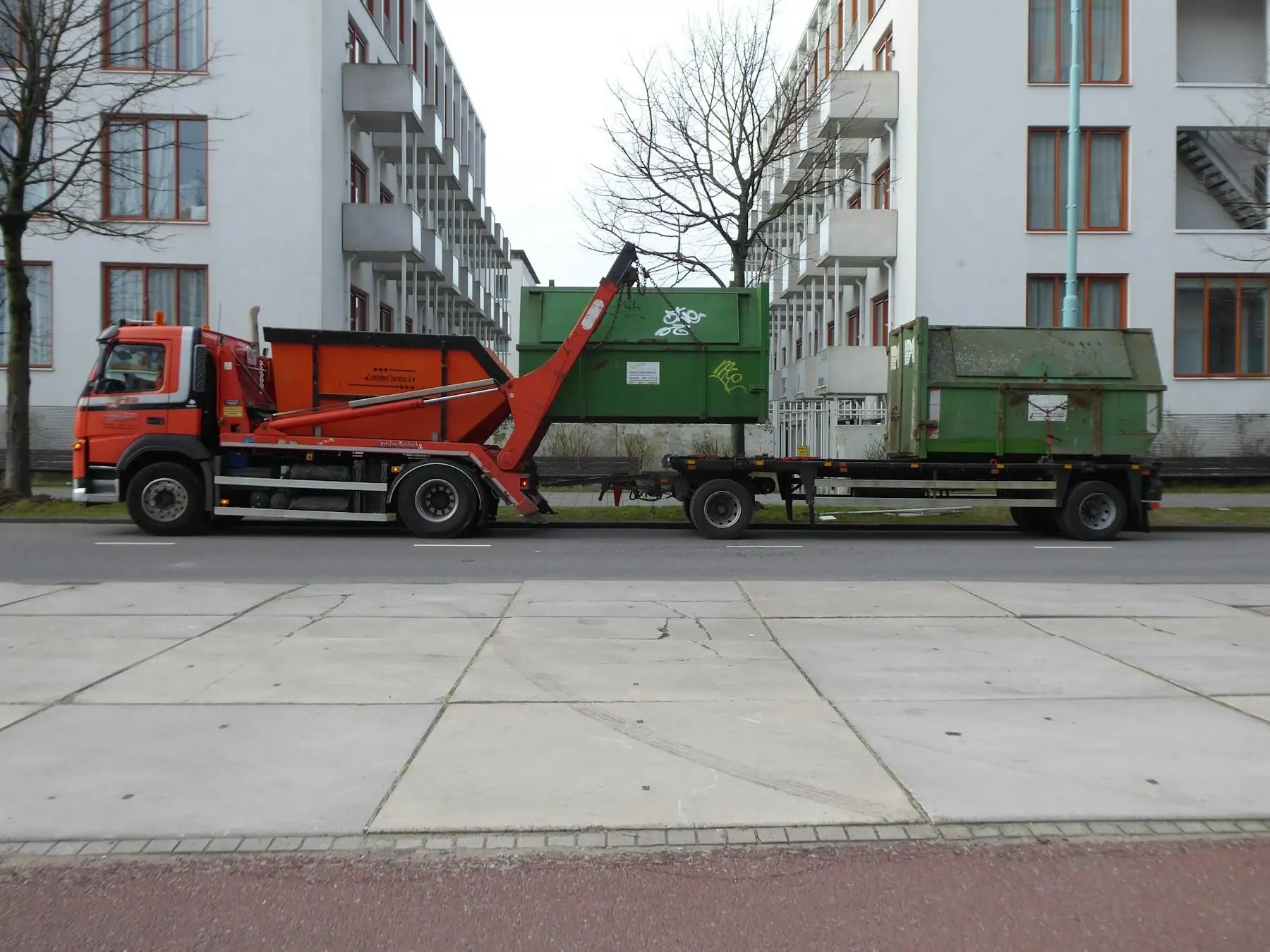
Nothing derails a Saturday cleanout faster than a trailer that cannot get where it needs to go. The good news is that a dump trailer needs far less room than a roll-off truck, because it is towed in and backed like any other trailer instead of needing space to tilt a bed six feet in the air. The better news is that fifteen minutes with a tape measure the week before delivery guarantees the whole thing goes smoothly.
Here is the checklist we would run if we were standing in your driveway with you.
Measure the parking footprint, then add working room
The trailer itself has a footprint, but the footprint is not the whole story. You need the space the trailer occupies plus the room to actually use it. Walk out and measure:
- Length of the flat, usable area where you want it to sit — not the whole driveway, just the part that is level and firm
- Width at the narrowest point of the approach, including where the drive necks down between a mailbox and a landscape bed
- Swing room behind the tailgate — you need clearance for the doors to open fully and for a person with a wheelbarrow to stand there
- Room for us to back in — a straight-ish approach from the street is ideal, though a modest angle is workable
If you have a standard two-car Clearwater driveway, you are almost certainly fine. The tight cases tend to be townhomes, duplexes with shared drives, and older homes in Dunedin or St. Petersburg where the drive is a pair of ribbon strips with grass down the middle.
Look up. Overhead clearance is the one people forget
This is the number one cause of a failed placement. Everybody measures the ground and nobody looks at the sky. Check for:
- Low tree limbs — live oaks around Safety Harbor and Palm Harbor are famous for canopy that hangs right over the drive
- The service drop from the pole to your house
- Carport roofs, porte-cocheres and awnings
- Basketball hoops mounted over the drive
- Low garage door headers if you were thinking of tucking the trailer partly inside — do not
A tow vehicle needs headroom on the way in and out, and the trailer bed needs headroom when it tips to dump. If the only spot with ground clearance sits under a heavy limb, tell us and we will plan around it or suggest a street-side placement.
Gates, side yards and backyard access
Sometimes the debris is in the backyard and the natural instinct is to ask for the trailer back there. Sometimes that works. Often it does not, and the honest answer is that the driveway plus a wheelbarrow is faster than a trailer that gets stuck.
If you want it behind the house, measure the gate opening at its narrowest, including the latch hardware and any gate post that leans. Then measure the path between the house and the fence, including the AC condenser pad, the hose bib, and the meter box. Then think about the ground: a loaded trailer on soft, wet Florida turf will rut and sink, and after a week of Gulf rain that is a near-certainty.
Slope, crown and the drainage swale
Most Pinellas driveways slope toward the street for drainage, which is fine — a modest slope is normal and we level with the jack and blocks. What causes trouble is a steep apron, a sharp break where the drive meets the road, or a deep swale at the sidewalk. A low-clearance tow vehicle can drag on a hard break, and a steeply pitched pad makes the trailer want to sit unevenly.
- Sight down the driveway from the side — if there is a pronounced hump or dip where it meets the street, mention it
- Note any drainage swale that has to be crossed and how deep it is
- Note any bump-up where a repaved road left a lip
Clear the spot the day before, not the morning of
Delivery goes fastest when the pad is genuinely empty. Do this the night before so you are not doing it in your bathrobe at 7 a.m.:
- 1Move every vehicle you are not using — including the one you park on the grass strip.
- 2Pick up hoses, sprinkler heads that stick up, planters, garden gnomes, bikes and kids' toys.
- 3Pull the trash and recycling bins somewhere they will not be in the way on collection day.
- 4Sweep loose gravel or shell off the pad if you have it.
- 5Lay a sheet of plywood where the jack foot will land if your surface is pavers, stamped concrete or soft asphalt.
- 6Mark the exact spot with a cone, a chalk X or a couple of bricks so there is no ambiguity if you are not home.
Think about where you will be standing, not just where it parks
The best-fitting placement is not always the best-working placement. Before you commit to a spot, walk the actual route you will take with a wheelbarrow fifty times. If the trailer is technically fitting but you have to go around the house to reach it, you have optimized the wrong thing. Move it closer to the debris even if the parking is slightly less elegant.
Also consider the neighbors. In tight Pinellas neighborhoods a trailer that fits your drive can still block a shared entrance or crowd a mailbox. And if your street or HOA has rules about containers in the right-of-way, check with the City of Clearwater or your own municipality before assuming a street placement is allowed. Rules vary from city to city here and it is not worth a citation.
If it truly does not fit
It happens, and there are options. We can often find a spot you did not consider. We can stage on the street where it is permitted. Or we can skip the trailer entirely and run a full-service haul where we bring the truck, load it ourselves and take it away in one visit — which is frequently the right call for a condo, a townhouse, or a house on a postage-stamp lot.
Send us your three photos and the tightest measurement you took, and we will tell you honestly whether a 10-yard trailer works in your space. Reserve your date at robertlesliehauling.com or ring (727) 779-8919 and we will figure the placement out together before delivery day.
Book a 10-yard dump trailer
Free local delivery, free pickup, and a family-owned crew that shows up when we say we will. Serving Clearwater, Pinellas, Hillsborough and Pasco.