Every hurricane season, somebody in Pinellas County loses a window not to the storm but to their own patio chair. Wind does not care what an object was designed for. A cracked planter, a stack of leftover pavers, a rotten fence panel leaning behind the shed — in 90 mph gusts those are all the same thing: a projectile aimed at your house, or at the neighbor's.
The good news is that this is the one part of storm season you have complete control over, and you can do it on a calm Saturday in June instead of in a panic on a Wednesday when the cone is over Tampa Bay. Here is what actually needs to leave the property, and how to get rid of it in a single load instead of six trips to the transfer station.
Walk the property like the wind will
Do a slow lap of the yard and ask one question about every single object: if this were airborne, what would it hit? Not "is this valuable" or "might I use this someday." Just: is it loose, and is it heavy enough to break something?
The usual suspects in a Clearwater or Largo backyard:
- Broken or brittle plastic furniture, especially anything sun-rotted enough that it will shatter rather than tumble.
- Terra cotta and concrete planters. Heavy, hard, and they do not need much wind to roll into a slider.
- Leftover construction material: scrap lumber, a half-pallet of pavers, a stack of roof tiles from a repair three years ago, a pile of fence pickets.
- The dead or dying fence panels and lattice you have been meaning to replace. Wind will replace them for you, into the pool cage.
- Old grills, dead lawn equipment, a rusted-out wheelbarrow, the bike frame with no wheels.
- Rotten pressure-treated deck boards and the pile of "I'll burn it someday" wood behind the shed.
- Anything stored on a screened lanai that is not bolted down. A lanai is not a wind-rated enclosure.
The rule of thumb: if you would not want it thrown at your sliding glass door, it either comes inside, gets anchored, or leaves the property. There is no fourth option, and "I'll bring it in when a storm comes" is how people end up hauling patio furniture in the rain at midnight.
Trim before the season, not during the warning
Tree work is the highest-value pre-storm task and the one most likely to be left too late. Dead limbs, overhanging branches, and unbalanced canopies are the difference between a scary night and a hole in your roof.
- Remove dead and dying limbs, especially anything overhanging the house, the driveway, or the power drop.
- Thin dense canopies so wind can pass through rather than pushing the whole tree like a sail.
- Deal with palms honestly: dead fronds and old seed pods are heavy, sharp, and they fly. Get them off before the season.
- Do not top trees. Topping produces weak regrowth that fails in the next storm. Hire an arborist if you are unsure.
One important timing note: once a storm is actually approaching, most municipalities ask you to stop putting yard waste at the curb, because uncollected piles become the projectiles. Do your trimming early enough that the debris is gone before there is anything in the Gulf worth watching. If you are trimming in June, you are doing it right. If you are trimming the day the watch goes up, the debris is now your problem to contain.
The shed, the garage, and the side yard
Pre-storm prep is also the moment to be honest about the stuff you have been storing. Every square foot of shed and garage floor occupied by junk is a square foot you do not have when you suddenly need to bring in the patio set, the grill, and the kids' bikes on short notice.
Clearing the garage before hurricane season does two jobs at once: it removes projectiles and it buys you the staging space you will need when a storm is 48 hours out. Homes in flood-prone parts of Pinellas get a third benefit — anything you would have to move up off the floor in a hurry is something you could simply not own anymore.
Haul it in one pass, not six
The reason pre-storm cleanup gets postponed is almost never that people do not know what to remove. It is that removal is a hassle. Fence panels do not fit in a sedan. Broken planters and old pavers will destroy your suspension. Nobody wants to spend three Saturdays making trips.
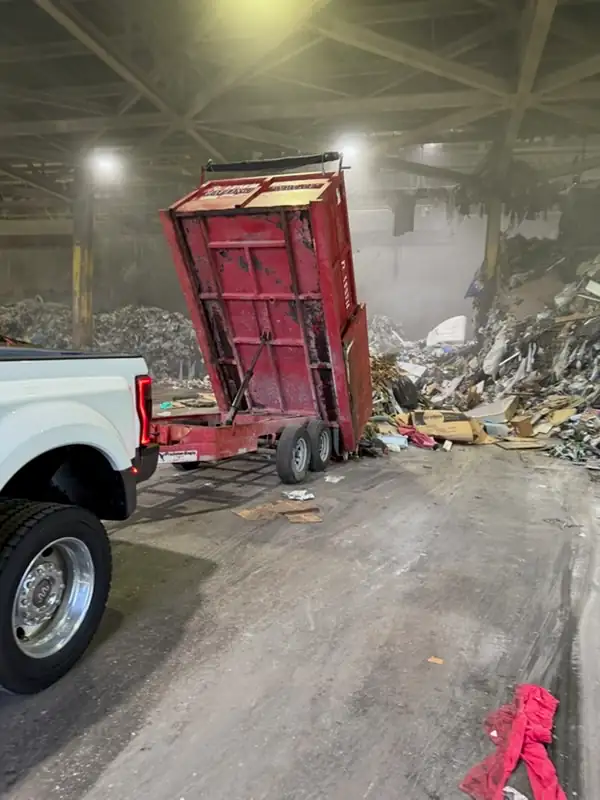
A 10-yard dump trailer in the driveway solves that. You load it on your own schedule over a weekend, mixing the fence panels, the busted furniture, the scrap lumber, and the trimmings, and it goes away in one pass. A few things to plan for when you load:
- Brush and fronds are bulky but light — they eat volume, not weight. Cut them down and stack them so they nest instead of bridging, and you will fit far more than you expect.
- Pavers, rock, broken concrete, and soil are the opposite: extremely dense. Heavy material like this is limited to roughly 5 yards per load, and it can hit a weight allowance while the trailer still looks half empty.
- Break down bulky items — a disassembled shed or a busted patio set takes a fraction of the space intact ones do. You are paying to haul debris, not air.
- Keep hazardous material out of the load entirely: old pool chemicals, fuel cans, propane cylinders, paint, and pesticides all need a household hazardous waste drop-off, not a trailer.
A simple pre-season checklist
- 1Walk the property and mark everything loose. Be ruthless.
- 2Book the tree work early — good arborists in Pinellas fill up as soon as the season is announced.
- 3Clear the shed and garage so you have staging room for the things that come inside.
- 4Fix or remove failing fence panels and lattice before the wind decides for you.
- 5Book a trailer, load it over a weekend, and be done before the first cone shows up.
We drop 10-yard dump trailers across Pinellas, Hillsborough and Pasco — free local delivery and pickup, and you can reserve your date online at robertlesliehauling.com or by calling (727) 779-8919. Get this done in June and you will be very glad you did in September.
Book a 10-yard dump trailer
Free local delivery, free pickup, and a family-owned crew that shows up when we say we will. Serving Clearwater, Pinellas, Hillsborough and Pasco.