The hours right after a storm passes over Pinellas County are loud, disorienting, and full of pressure to just start dragging things to the curb. Resist that for a minute. The order you do things in during the first 72 hours has a bigger effect on your insurance claim, your health, and how long your yard stays a disaster than almost anything else you do later.
This is the sequence we would follow ourselves, and it is the sequence we watch work out well for homeowners from Clearwater to Safety Harbor every hurricane season. Safety first, documentation second, sorting third, hauling fourth. Skip a step and you pay for it.
Hour 0 to 6: Assume everything is dangerous
Storm cleanup injuries almost never happen during the storm. They happen the morning after, when people are tired, in flip-flops, and moving fast. Before you touch a single branch:
- Treat every downed line as live, including cable and phone lines that are tangled with power lines. Do not move a branch that is touching a wire. Call the utility and wait.
- Do not walk through standing water. In a low-lying coastal county, that water can be carrying sewage, fuel, fire ants, and a live circuit from a submerged outlet or a neighbor's generator.
- Never run a generator in a garage, carport, or anywhere near an open window. Carbon monoxide is the quiet killer of storm week.
- Boots, long pants, gloves, eye protection. Roofing nails and screws are everywhere in the debris field, and a puncture wound in warm standing water is not a small problem.
- If your home flooded and the power is on, kill the breaker before you go poking at wet walls and outlets.
If a chainsaw is involved and you are not experienced with one, that is the moment to hire somebody. Every storm season, the emergency rooms in Pinellas fill up with people who were fine through 100 mph winds and then met a kickback on Saturday morning.
Hour 6 to 24: Document before you throw anything away
This is the step people skip, and it is the expensive one. Once a soaked mattress or a ruined outboard motor is in a pile at the curb, it stops being evidence and becomes trash. Adjusters are working thousands of claims after a big event. Your file is only as strong as what you captured.
- 1Photograph and video the whole property before you move anything: wide shots from the street, each room, each exterior elevation, the roof if you can see it safely from the ground.
- 2Capture the waterline. Photograph how high the water rose on walls, cabinets, and furniture, with something in frame for scale — a tape measure is ideal. That height drives a lot of the claim.
- 3Get serial numbers and model numbers off appliances, HVAC equipment, water heaters, TVs, and tools. Photograph the data plates.
- 4Keep a written inventory as you go — item, rough age, rough replacement value. Do it on your phone if that is all you have.
- 5Photograph the debris pile itself once it exists, and again after it is removed. Save your receipts for anything you rent, buy, or hire out.
Call your insurer and open the claim early even if you do not have a full picture yet. Then keep documenting. Nobody in the history of storm claims has ever regretted taking too many photos.
Hour 24 to 48: Sort while you drag, not after
Here is a detail that catches people every single storm season: county and municipal debris programs generally handle vegetative debris and construction/household debris as separate streams. Branches and palm fronds are collected by one kind of pass. Drywall, carpet, ruined furniture, fencing, and roofing are collected by another. If you mix them into one heap at the curb, the crews can and do skip the pile entirely — and then you are waiting for the next round.
So sort as you drag. It costs you nothing to make two piles instead of one, and it costs you weeks to make the wrong one.
- Vegetative: limbs, palm fronds, brush, leaves, trunk sections. Bulky, light, eats volume fast.
- Construction and demolition: drywall, insulation, flooring, cabinetry, fencing, shingles, lumber.
- Household and appliances: furniture, mattresses, ruined contents, white goods.
- Hazardous: paint, fuel, pool chemicals, propane cylinders, batteries. These do not go in a curb pile and they do not go in a rented trailer. Hold them for a household hazardous waste drop-off.
Check your city's storm debris instructions before you build the pile. Clearwater, Largo, Dunedin, Palm Harbor and St. Petersburg do not all run the same playbook, and after a major event the rules get published fast and change fast. Keep the pile out of the street, off storm drains, away from mailboxes, hydrants, and utility boxes, and clear of low wires.
Hour 48 to 72: Get it off your property
Free curbside debris pickup will come. It just may not come soon. After a significant storm, a county the size of Pinellas is running debris passes for weeks, sometimes longer, and the first pass on your street may not be the pass that takes your particular pile. Meanwhile that heap is breeding mosquitoes, sinking into your grass, and blocking the driveway you need for a roofer.
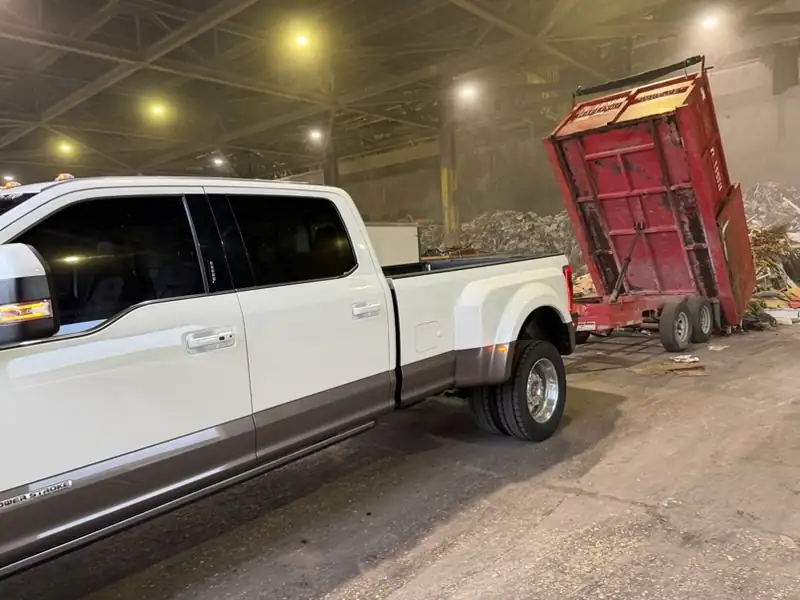
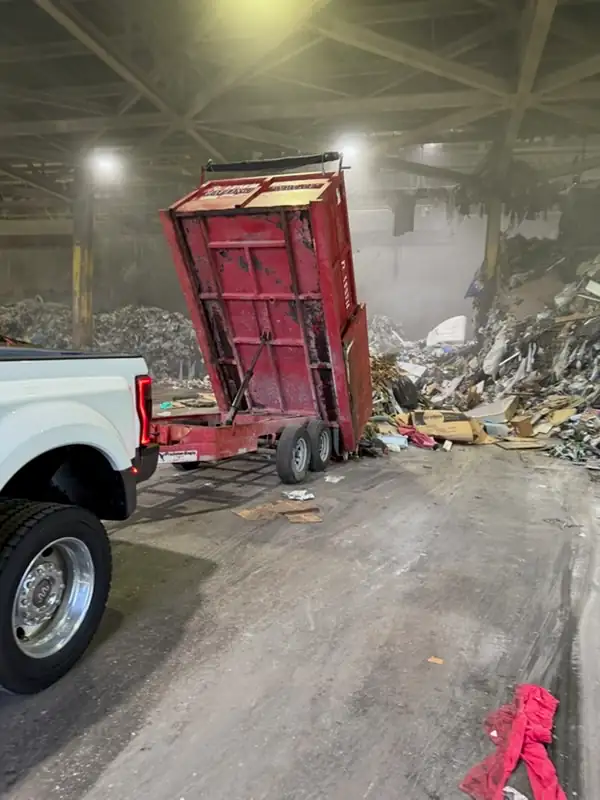
That is the real reason people rent their own trailer after a storm. It is not impatience — it is the difference between starting your repairs this week and starting them next month. A 10-yard dump trailer sits in the driveway, you load it on your own schedule, and it leaves when you are done. Wet materials are heavy, so keep an eye on the tonnage allowance included with your rental; overage is billed per ton and we provide a certified scale receipt when weight matters. Heavy material like soil, rock, and concrete is limited to roughly 5 yards per load for safety.
One more thing worth saying plainly: after a storm, contractors appear out of nowhere. Some are good. Some are gone with your deposit by Thursday. Do not pay large sums up front to somebody who knocked on your door, do not sign anything that assigns your insurance benefits to a stranger, and be skeptical of anyone who cannot show you a license and a local address.
A realistic 72-hour plan
- 1Day 1: Safety sweep. Photos and video of everything, inside and out. Open the insurance claim. Tarp what is open to the sky if you can do it safely.
- 2Day 2: Sort into separated piles. Pull soaked porous materials out of the house so mold does not get a two-week head start. Keep documenting as you go.
- 3Day 3: Load and haul. Get the debris off the property so contractors have room to work and your yard stops being a hazard.
When you are ready to clear it out, we can drop a 10-yard dump trailer in your driveway — free local delivery and pickup, book and pay online at robertlesliehauling.com, or call us at (727) 779-8919. Demand spikes hard after a storm and dates go first-come, so if you know you are going to need one, reserve it early rather than waiting for the pile to get worse.
Book a 10-yard dump trailer
Free local delivery, free pickup, and a family-owned crew that shows up when we say we will. Serving Clearwater, Pinellas, Hillsborough and Pasco.