Deck removal is one of the more satisfying demolition jobs and one where the sequence genuinely matters — mostly for safety.
Before you start
- **Check for utilities.** Gas lines, electrical for lighting or a hot tub, and irrigation frequently run under or through a deck.
- **Disconnect any electrical** properly at the breaker, and have it disconnected by an electrician if you are not certain.
- **Look at how it attaches** to the house. The ledger is bolted or lagged into the framing, and how you remove it determines what the wall behind looks like afterward.
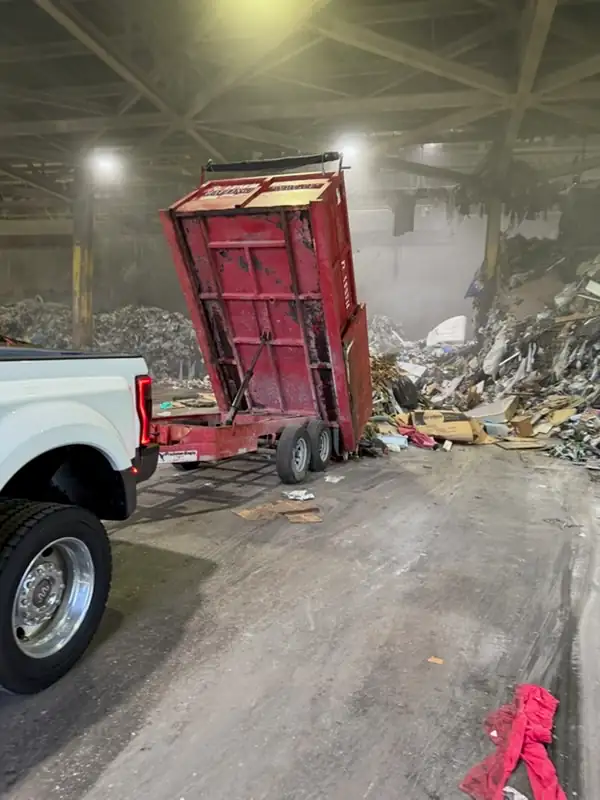
- **Plan the trailer placement** as close to the deck as access allows.
The sequence
- 1**Railings first.** They are the trip hazard and they come off easily. Once they are gone the deck is an open platform, so watch the edges.
- 2**Decking boards next**, working from the outside edge back toward the house. A flat pry bar and a hammer, or a dedicated deck board removal tool.
- 3**Stairs**, once you no longer need them for access.
- 4**Joists and blocking.**
- 5**The beam and ledger.** The ledger is last on the house side, and this is where you find out whether water has been getting behind it.
- 6**Posts and footings**, which is the decision below.
Footings — pull or leave?
**Leave them** if a new deck is going in and the layout works with existing post positions, or if they are below grade and the area is being landscaped over.
**Pull them** if the area is becoming lawn, patio or garden, or if the new structure needs different positions.
Pulling concrete footings is the heaviest part of the job. Each one is a substantial lump of concrete, and a deck with a dozen of them adds up fast. Load them flat on the trailer floor, spread out and shallow — heavy material never fills a tub.
What fills the trailer
A typical residential deck — say 12 by 16 — broken down will use most of a 10-yard trailer:
- Decking boards, stacked flat, are the bulk of the volume
- Joists and beams stack tightly along the length
- Railings and balusters are surprisingly bulky, so break them down
- Stairs and stringers
- Any lattice or skirting, which is mostly air until you break it
Add footings and you are into weight territory. Add a larger deck, a pergola or a hot tub and it is two loads.
Composite versus wood
Composite decking is heavier per board than wood and it does not break as readily. It stacks well but the weight adds up faster than people expect on a large deck.
Pressure-treated wood is fine in the trailer — see our guide on treated lumber — but it must never be burned or chipped.
Fasteners
A deck contains hundreds of screws and nails. Most stay in the lumber, which is fine. What matters is the ones that end up on the ground.
Sweep with a magnet at the end. It takes ten minutes and it saves a flat tire, a nail through a shoe, or a mower blade.
Safety
- Old decks fail in unpredictable places. Do not stand on a section you have already partially dismantled.
- Work with someone rather than alone on anything above ground level.
- Boots, gloves and eye protection throughout.
- Watch for wasp and hornet nests under the deck, which is extremely common here.
- Snakes and other wildlife live under Florida decks. Look before you reach.
Plan the load
Tell us the deck size, the material and whether the footings are coming out. Call (727) 779-8919 and we will size it honestly.
Book a 10-yard dump trailer
Free local delivery, free pickup, and a family-owned crew that shows up when we say we will. Serving Clearwater, Pinellas, Hillsborough and Pasco.