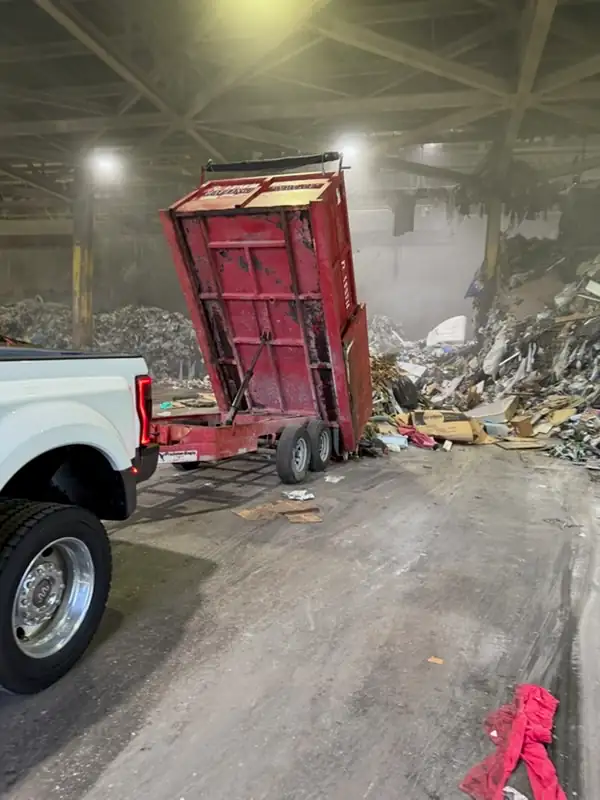
If you run a two-to-five-man crew across Pinellas and Hillsborough, you already know the shape of the problem. You are never on one job. You are on a kitchen in Clearwater in the morning and a bath in Safety Harbor after lunch, and both of them make debris, and the debris does not care about your schedule. What kills the week is not the work. It is the twenty minutes here and forty minutes there spent moving the same pile of drywall twice.
This is a workflow, not a lecture. It is built around one principle that most small contractors learn the expensive way: a trailer that sits full is a trailer you are paying for and getting nothing from. Full is not the goal. Gone is the goal.
The one number that runs the whole system
Every rental day is a fixed cost against a job. So the metric that matters is not how much debris you moved, it is how much of the trailer's time was productive. A trailer that arrives Monday, gets loaded Monday, and gets hauled Tuesday morning is doing its job. A trailer that arrives Monday, gets half filled, then sits through Tuesday and Wednesday while your crew is across the bridge on another job, is a line item eating your margin in silence.
So the rule is simple. Do not book a trailer for a job. Book a trailer for a demo window. The window is the block of time when your crew is physically producing debris, and it should be as tight as you can make it.
Stack your demo, do not spread it
The natural rhythm of running two jobs is to bounce: demo a little here, frame a little there. That is exactly what wrecks debris economics, because you end up needing a container present at two sites for a week each.
- 1Batch demo. Put all the heavy tear-out on both jobs into a compressed window, even if it means pushing finish work a couple of days. Crews hate this at first and then never go back.
- 2Bring the trailer in for that window and stage it at the site producing the most debris by weight, not the site that is most convenient to park at.
- 3Load continuously, never into a ground pile. A ground pile is double handling, and double handling is the only pure loss in this business.
- 4Call the swap before the trailer is full, not after. If you wait until it is full, you have already lost the afternoon your crew spends standing around a mound of drywall with nowhere to put it.
- 5For the second site, run a back-to-back swap rather than one long rental. An empty trailer arriving as the full one leaves is nearly always better economics than one trailer sitting across both jobs for a week.
Staging on a live jobsite
Staging is where an experienced crew separates itself. The distance from the debris to the trailer is multiplied by every single trip your guys make, and on a full kitchen tear-out that is hundreds of trips.
- Park as close to the work as you can safely get, and accept the trade-off of a slightly worse pull-out for a much shorter carry
- Protect the surface. Plywood under the tongue jack and the tires on pavers, decorative concrete or fresh seal coat. You are the one who eats a damaged driveway on a client's home
- Check overhead before you commit. That dump body swings up several feet, and the oaks over driveways in Dunedin, Palm Harbor and half of St. Petersburg do not move
- Keep a straight pull-out. Backing a loaded trailer around a client's parked car at the end of a demo day is when driveways get scarred
- If the trailer has to go in the street or the right-of-way, call the City of Clearwater or the relevant municipality first and ask about placement rules, duration limits and whether an HOA overlay applies. Ask before, not after the complaint
Load like the load has to travel, because it does
A load has to sit level with the top rail so it can be tarped for transport. That is not a preference, it is how it legally leaves your jobsite. Crews that mound a load because they wanted to squeeze in one more cabinet end up unloading in the client's driveway, in front of the client.
- Heavy and flat first, spread across the floor of the bed and toward the axles. Stone countertops, tile, concrete, cast iron
- Bulk on top: cabinets broken down, drywall, framing lumber, packaging
- Break down anything hollow. An intact cabinet box or an unbroken appliance carton is mostly air, and air is the most expensive thing you can haul
- Keep the load below the rail line and walk it before you call for pickup
Know what you cannot load, before your helper loads it
Your newest guy does not know this list. Make sure he does, because a rejected load costs you a day.
- Asbestos-containing material. Old vinyl tile, cutback adhesive, pipe wrap and certain old roofing. If the building is old enough to make you pause, test it and handle it properly
- Hazardous waste of any kind, including paint, solvents, adhesives and any other liquids
- Compressed gas cylinders, including torch bottles and propane
- Biomedical waste, explosives and ammunition
Building it into your bid
The contractors who stop losing money on debris are the ones who stop treating it as an afterthought. Estimate it the same way you estimate labor: how many loads, what is the heavy fraction, how many days does the trailer need to be on site, and who is loading it. Then put it in the bid as its own line and stop absorbing it.
And if a job runs hot and your crew is buried, we have a full-service option where our crew does the loading for you, billed hourly, plus a flat option for a single item that just needs to disappear. On a week where your guys are worth more swinging hammers than carrying drywall, that math works out more often than most contractors expect.
We are family-owned, we run across Pinellas, Hillsborough and Pasco, and delivery and pickup are free within our local radius. If you want a hauler who understands that your schedule is the product, book a 10-yard dump trailer at robertlesliehauling.com or call (727) 779-8919 and let us build the swap schedule around your demo window.
Book a 10-yard dump trailer
Free local delivery, free pickup, and a family-owned crew that shows up when we say we will. Serving Clearwater, Pinellas, Hillsborough and Pasco.