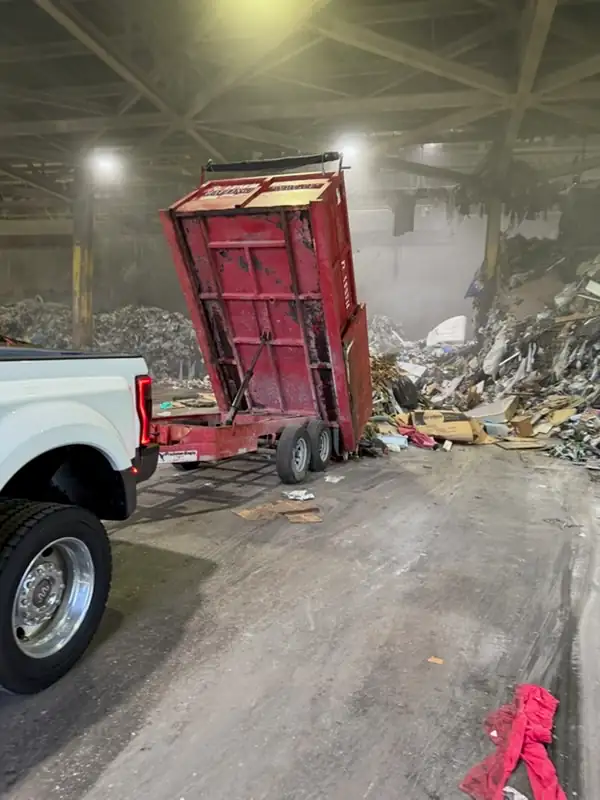
A roof tear-off is the one project where the debris plan matters as much as the roofing plan. Everything that comes off the deck has to land somewhere within a few hours, and on a typical Pinellas County lot there is not much somewhere to work with. Narrow driveways, mature oaks hanging over the apron, tight side yards, HOA streets in Palm Harbor and Safety Harbor that do not love a container parked out front for a week. The crew is fast. The debris is the bottleneck.
This is a working plan for a homeowner or a small roofing crew doing a residential tear-off in Clearwater, Largo, Dunedin or anywhere else across the county. It covers how to size the job by weight instead of by eye, where the trailer actually goes, how to sequence a single-day tear-off so nothing sits in the yard overnight, and the handful of things that will get a load turned away.
Count squares first, then think in pounds
Roofers measure in squares. One square is 100 square feet of roof surface. A simple gable ranch around here often lands somewhere in the low twenties of squares once you account for pitch and overhangs. A two-story with dormers, valleys and a porch roof can be double that. Get that number first, because how many loads you need, how long the trailer sits, and how you stage the day all come off it.
Then ask the question most homeowners skip entirely: how many layers are up there? Architectural shingles laid over an original three-tab layer is extremely common on homes built in the seventies and eighties across Largo and St. Petersburg. A second layer roughly doubles the weight of the debris for the exact same roof area. It does not double the volume in any dramatic way, because torn shingles pack down flat and heavy. It absolutely doubles what the scale reads.
That is the whole lesson of a roof job in one line: weight runs out before space does. You will look at a 10-yard dump trailer, see plenty of room above the shingles, and be nowhere near able to add another square. Things that quietly add weight:
- A second or third layer of shingles, which is the single biggest factor
- Wet decking or soaked underlayment after a Gulf Coast rain, which can add real weight overnight if the pile sits uncovered
- Rotten plywood you decide to replace once you can see the deck
- Old built-up or roll roofing, which is far denser than asphalt shingles
- Nails, drip edge, flashing, boots and vents, which add up more than people expect
Why a dump trailer suits a residential tear-off
A 10-yard dump trailer rolls in on tires, sits where you want it, and rolls back out. There is no steel container skidding across your pavers, and the loading height is lower than a roll-off box, which matters when your crew is pitching shingles off a one-story eave by hand. Delivery and pickup are free within our local radius across Pinellas, Hillsborough and Pasco.
The trade-off is that a trailer needs a straight shot in and out, which leads directly to staging, and staging is where most roof jobs go wrong.
Staging: where the trailer goes, and what to check first
Walk the site the day before with a tape measure and your head up. You are looking for three things: a clear approach, a level parking spot on the tear-off side of the house, and nothing overhead that a loaded trailer has to duck under on the way out.
- Park the trailer on the side you are stripping first, as close to the eave as you can safely get without putting it under the drop zone
- Lay plywood or old plyboard on the driveway apron and under the tongue jack if you have pavers, decorative concrete or a fresh seal coat
- Check overhead clearance for the raised dump body, not just the trailer height at rest, because that body swings up several feet and oaks are everywhere in Dunedin and Safety Harbor
- Leave a straight pull-out. Backing a loaded trailer around a parked car in a cul-de-sac at the end of a long day is how driveways get damaged
- If the only workable spot is the street or the right-of-way, call ahead. Ask the City of Clearwater or Pinellas County whether a placement permit is required on your street, how long a trailer can sit, and whether an HOA overlay applies
A realistic one-day sequence
- 1Day before: trailer is delivered and staged. Tarps go down over landscaping, the AC condenser, and anything you do not want a nail in. Move both cars out of the driveway now, not at 7am.
- 2Early morning: strip the first slope. This is the heaviest, fastest part of the day and the trailer should be right there for it.
- 3Load as you go, never into a ground pile. A pile on the lawn gets handled twice, kills the grass, and soaks up water if a Gulf storm rolls through at three in the afternoon.
- 4Mid-morning: stop and look at the load. If you are near the tonnage allowance and you still have half a roof, call for the swap now rather than at four in the afternoon when the day is already lost.
- 5Inspect the exposed deck. Mark and replace rot immediately. Old plywood is heavy, so it counts against the same allowance and it should go in with the first load rather than on top of a nearly full trailer.
- 6Dry in before you clean up. Underlayment on the deck comes before the yard sweep, because weather beats tidiness every time in this county.
- 7Final sweep: run a magnet over the driveway, the lawn, the flower beds and the street. Twice. Do this before the trailer leaves, so any last odds and ends go with it.
What will stop a load cold
Some things simply cannot go in a dump trailer. On a roof job the ones that come up are worth knowing before you are standing on a ladder holding one:
- Asbestos-containing material. On very old structures, certain roll roofing, mastics and flashing cements may contain asbestos. If the building is old enough to make you wonder, stop and have it tested. It cannot go in the trailer, and it is not a judgment call you want to make from the ladder.
- Liquids, including open buckets of wet roof coating, cement or tar
- Compressed gas cylinders, including torch bottles from a torch-down job
- Hazardous waste, biomedical waste, explosives and ammunition
Load it level so it can be tarped
The load has to sit level with the top rail so it can be tarped for transport. Nothing mounded over the rail, nothing sticking out. Spread shingles across the floor and toward the axles rather than piling everything at the tailgate, and break down bundles of felt and flat stock so they lay in rather than bridging across the top. A trailer that cannot be tarped cannot legally leave your driveway, and that is a delay nobody needs at the end of a tear-off day.
If you have a tear-off coming up anywhere in Pinellas, Hillsborough or Pasco, get the trailer on the calendar before the crew, not after. You can book online at robertlesliehauling.com and a deposit holds your date, or call us at (727) 779-8919 and we will talk through squares, layers and how many loads the job really needs.
Book a 10-yard dump trailer
Free local delivery, free pickup, and a family-owned crew that shows up when we say we will. Serving Clearwater, Pinellas, Hillsborough and Pasco.