Pool cages are among the first things to fail in a Florida storm. They are also among the most awkward things to haul, because a collapsed cage is a large tangle of thin aluminum and screen.
Safety first
A damaged enclosure is under tension in ways that are not obvious.
- **Do not enter a partially collapsed cage.** Members under load release unpredictably.
- **Watch for downed power** in and around the structure.
- **Aluminum edges are sharp** and screen is under tension. Heavy gloves, eye protection, long sleeves, boots.
- **Have someone with you.** Sections shift as you cut.
- **If a large section is still standing but damaged**, that may be a job for someone with the right equipment rather than a homeowner with a saw.
Document it before you touch it
If you are making an insurance claim, photograph and video everything before moving a single piece — wide shots showing context and close-ups showing detail.
This is the single most valuable ten minutes of a storm cleanup and the one most often skipped in the rush to clear. Our guide on post-storm documentation covers it.
Breaking it down
- 1Cut the screen away from the frame first with a utility knife and roll it. Rolled screen packs; loose screen tangles with everything.
- 2Separate the aluminum members at the fasteners where you can, or cut them into manageable lengths.
- 3Stack aluminum in the same orientation, like lumber, rather than crossing pieces.
- 4Keep the fasteners and hardware bagged rather than loose.
- 5Kick plates and any panel sections stack flat.
It is bulky, not heavy
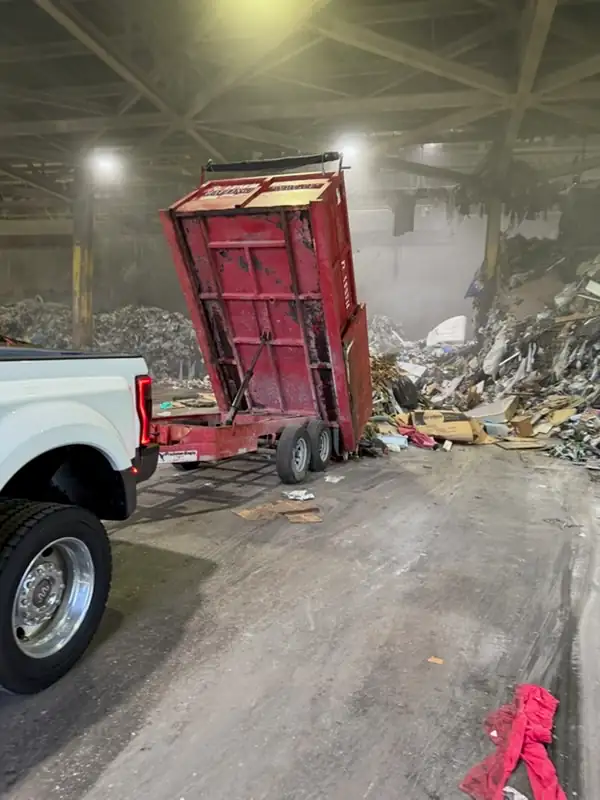
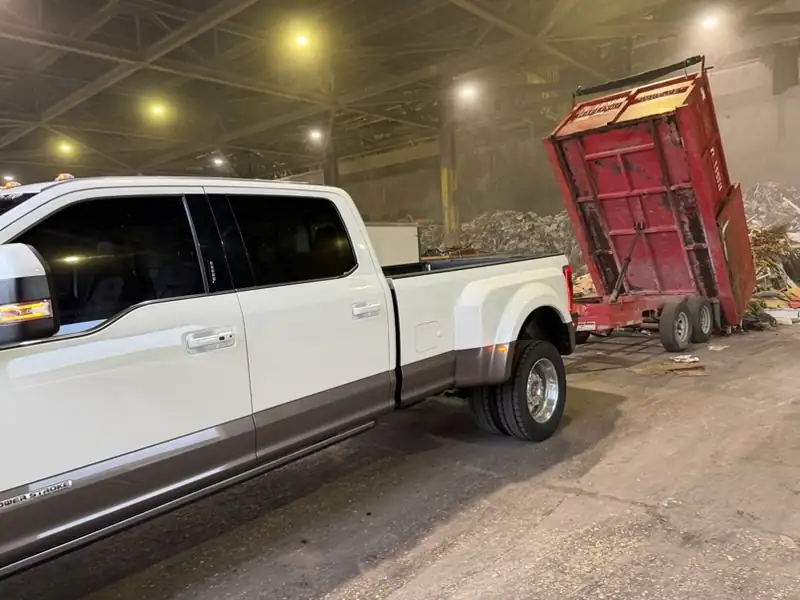
A full pool cage is a large volume of very light material. A 10-yard trailer takes a substantial enclosure once broken down and stacked properly — and almost none of it if it goes in as a tangle.
This is the material where an hour of cutting and stacking most obviously pays for itself.
What goes where
- **Aluminum frame** — scrap metal, worth separating
- **Screen** — general debris, roll it
- **Kick plates** — usually aluminum or vinyl
- **Fasteners and hardware** — bag them; the small ones end up in tires otherwise
- **Any concrete footing or anchor** that comes out — heavy material, flat on the floor
- **Roof panels**, on a cage with a solid roof section — usually aluminum or polycarbonate
Storm debris collection
After a declared storm event, local governments across Pinellas, Hillsborough and Pasco frequently run separate debris collection with specific rules about what is collected, how it must be sorted at the curb, and for how long the program runs.
Check what is being collected in your area before paying to haul anything. Construction and demolition debris, vegetative debris and appliances are often collected as separate streams on separate passes. Our hurricane debris guide covers the general pattern.
Rebuilding
If the cage is being rebuilt, coordinate the debris removal with the contractor's schedule. Clearing the site fully before they arrive usually speeds the rebuild and avoids paying twice for the same handling.
Call (727) 779-8919 and tell us what came down.
Book a 10-yard dump trailer
Free local delivery, free pickup, and a family-owned crew that shows up when we say we will. Serving Clearwater, Pinellas, Hillsborough and Pasco.